|
Zhanyi Sun I am a second-year Ph.D. student at Stanford University advised by Prof. Shuran Song in the Robotics and Embodied AI (REAL) Lab. Prior to Stanford, I was a MS-Research student in the CMU Robotics Institute, advised by Prof. David Held and Prof. Zackory Erickson. Prior to CMU, I earned my B.A. in Computer Science and B.S. in Electrical Engineering from Rice University. |
|
Research InterestMy research aims to develop robotic systems that achieve human-like intelligence and dexterity and operate in complex and evolving environments with safety, robustness, and trustworthiness. 🤖 |
Selected Publications (* indicates equal contribution) |
|
|
From Prior to Pro: Efficient Skill Mastery via Distribution Contractive RL Finetuning
Zhanyi Sun, Shuran Song International Conference on Machine Learning (ICML), 2026 Project Page | Paper | Code | Data | Model We introduce Distribution Contractive Reinforcement Learning (DICE-RL), a framework that uses reinforcement learning (RL) as a "distribution contraction" operator to refine pretrained generative robot policies. DICE-RL turns a pretrained behavior prior into a high-performing "pro" policy by amplifying high-success behaviors from online feedback. It enables mastery of complex long-horizon manipulation skills directly from high-dimensional pixel inputs, both in simulation and on a real robot. |
|
|
Latent Policy Barrier: Learning Robust Visuomotor Policies by Staying In-Distribution
Zhanyi Sun, Shuran Song Conference on Neural Information Processing Systems (NeurIPS), 2025, Spotlight Paper 🎉 Project Page | Paper | Code We introduce Latent Policy Barrier, a framework for robust visuomotor policy learning. LPB treats the latent embeddings of expert demonstrations as an implicit barrier separating safe, in-distribution states from unsafe, out-of-distribution (OOD) ones. Our approach decouples the role of precise expert imitation and OOD recovery into a base diffusion policy and a dynamics model. At inference time, the dynamics model predicts future latent states and optimizes them to stay within the expert distribution. |
|
|
RL-VLM-F: Reinforcement Learning from Vision Language Foundation Model Feedback
Yufei Wang*, Zhanyi Sun*, Jesse Zhang, Xian Zhou, Erdem Bıyık, David Held†, Zackory Erickson† International Conference on Machine Learning (ICML), 2024 Project Page | Paper | Code We introduce a method that automatically generates reward functions for agents to learn new tasks using only a text description of the task goal and the agent’s visual observations, by leveraging feedback from vision language foundation models (VLMs). |
|
Force Constrained Visual Policy: Safe Robot-Assisted Dressing via Multi-Modal Sensing
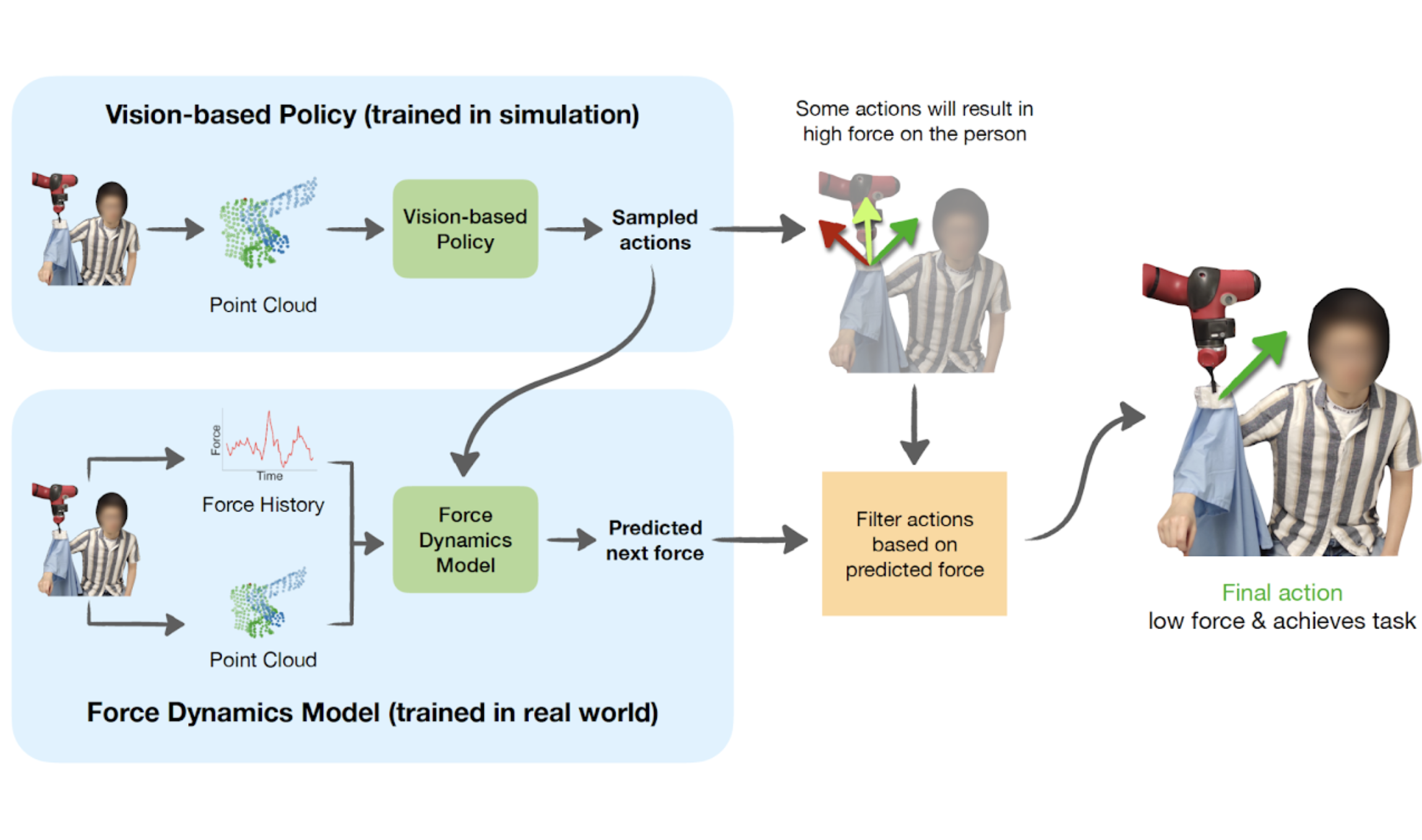
Zhanyi Sun*, Yufei Wang*, David Held†, Zackory Erickson† IEEE Robotics and Automation Letters (RA-L), 2024 Project Page | Paper We introduce a method that leverages both vision and force modalities for robot-assisted dressing. Our method combines the vision-based policy, trained in simulation, with the force dynamics model, learned in the real world to achieve better dressing performance and safety for the user. |
|
|
One Policy to Dress Them All: Learning to Dress People with Diverse Poses and Garments
Yufei Wang, Zhanyi Sun, Zackory Erickson*, David Held* Robotics: Science and Systems (RSS), 2023 Project Page | Paper | Video | CMU Research Highlights We develop, for the first time, a robot-assisted dressing system that is able to dress different garments on people with diverse body shapes and poses from partial point cloud observations, based on a single reinforcement learning policy. |
|
|
Human-guided motion planning in partially observable environments
Carlos Quintero-Pena*, Constantinos Chamzas*, Zhanyi Sun, Vaibhav Unhelkar, Lydia E. Kavraki International Conference on Robotics and Automation (ICRA), 2022 Project Page | Paper | Video | Futurity Research News Review We propose a method that leverages human guidance for high DOF robot motion planning in partial observable environments. We project the robot’s continuous configuration space to a discrete task model and utilize inverse RL to learn motion-level guidance from human critiques. |
Education |

|
Carnegie Mellon University
Master of Science in Robotics (MSR) Aug '22 - Jun '24 |

|
Rice University
B.A. in Computer Science, B.S. in Electrical Engineering Aug '18 - May '22 |
|
Website template from Jon Barron. |